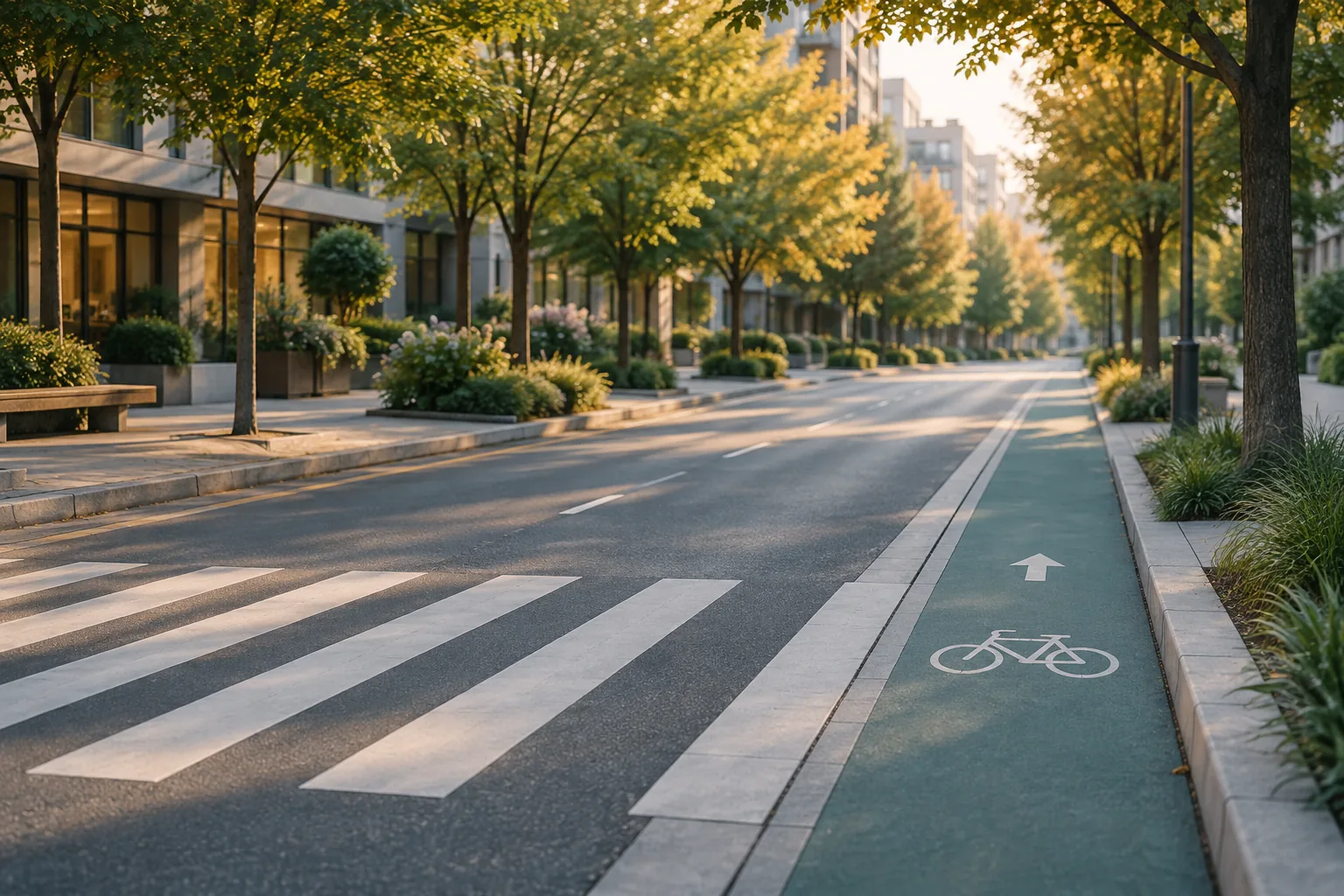
Pedestrians always have right of way in marked or unmarked crosswalks. Cyclists are entitled to use the full lane in many situations, and most states require drivers to give at least three feet of clearance when passing.
What the exam tests
Pedestrians and Bicycles is one of the topic areas every state DMV exam pulls from. Expect roughly two to five questions per exam from this category, depending on your state. The questions test both your recognition of the underlying rule and your ability to apply it to a specific scenario such as a four way stop, a yellow advisory speed sign, a school bus with extended stop arm, or an emergency vehicle approaching from behind.
Core rules to remember
Sharing the road with vulnerable users. The exam will phrase the question with a concrete scenario, then offer four answers that include the correct rule, a plausible distractor, an incorrect generalization, and a clearly wrong option. Read every choice before answering. Eliminate the obviously wrong options first, then choose the most precisely correct of the two that remain.
Practice questions on pedestrians and bicycles
Below is a sample of practice questions from this topic across multiple states. Each links to a long-form explanation page that walks through the rule, the safety reason, the most common driver mistake, and a study tip.
- A pedestrian steps off the curb at a marked crosswalk in front of you in Alabama. There is no signal at this intersection. What must you do? — Alabama
- A pedestrian steps off the curb at a marked crosswalk in front of you in Alaska. There is no signal at this intersection. What must you do? — Alaska
- A pedestrian steps off the curb at a marked crosswalk in front of you in Arizona. There is no signal at this intersection. What must you do? — Arizona
- A pedestrian steps off the curb at a marked crosswalk in front of you in Arkansas. There is no signal at this intersection. What must you do? — Arkansas
- A pedestrian steps off the curb at a marked crosswalk in front of you in California. There is no signal at this intersection. What must you do? — California
- A pedestrian steps off the curb at a marked crosswalk in front of you in Colorado. There is no signal at this intersection. What must you do? — Colorado
- A pedestrian steps off the curb at a marked crosswalk in front of you in Connecticut. There is no signal at this intersection. What must you do? — Connecticut
- A pedestrian steps off the curb at a marked crosswalk in front of you in Delaware. There is no signal at this intersection. What must you do? — Delaware
- A pedestrian steps off the curb at a marked crosswalk in front of you in Florida. There is no signal at this intersection. What must you do? — Florida
- A pedestrian steps off the curb at a marked crosswalk in front of you in Georgia. There is no signal at this intersection. What must you do? — Georgia
- A pedestrian steps off the curb at a marked crosswalk in front of you in Hawaii. There is no signal at this intersection. What must you do? — Hawaii
- A pedestrian steps off the curb at a marked crosswalk in front of you in Idaho. There is no signal at this intersection. What must you do? — Idaho
Browse all 50 state practice tests →
Why this topic matters
Pedestrians and Bicycles questions are not the kind of trivia you can guess your way through. Get this topic wrong on the road and you risk a crash. Get it wrong on the exam and you delay your permit by at least a day, often a week. The rules in this category are written for the situations that historically cause the most fatalities, so the exam takes them seriously and so should you.